
Property Lawyers in Balwyn
Practical advice on boundaries, land tax, titles and property disputes
Not every property issue arises when you buy or sell. You may be in a disagreement with a neighbour about a boundary or fence, have received a land tax assessment you think is wrong, or want to understand an easement, covenant or caveat on your title. Grice Legal explains your rights, sets out the practical options and works to resolve the issue efficiently.
Property issues we assist with
We advise on boundary uncertainty, encroachments, adverse possession claims and dividing fence disputes, including fencing notices under the Fences Act 1968 (Vic).
Boundary and fencing disputes
We explain how easements and covenants affect your land and advise on options to vary or remove them where that is possible.
Easements and restrictive covenants
We review land tax assessments, exemptions and surcharges, and help prepare objections to the State Revenue Office within the required time.
Land tax assessments and objections
Where co-owners cannot agree about selling or dividing a property, we advise on negotiation and, if necessary, an application to VCAT.
Co-owner disputes
We advise on lodging, removing or challenging caveats, and on responding to a lapsing notice.
Caveats
We advise lot owners and owners corporations on fees, rules, repairs and disputes under the Owners Corporations Act 2006 (Vic).
Owners corporation issues
The steps depend on the issue, but most property law matters follow this pattern
-
![Business professionals discussing documents at an office meeting table]()
Step 1 – Initial conference
We discuss the issue, review the title, plans and correspondence, and identify any deadlines, such as objection or lapsing periods.
-
![Business professionals reviewing financial reports at an office desk with a laptop, calculator, and paperwork.]()
Step 2 – Investigate
We obtain the information needed, such as title searches, surveys, planning records or State Revenue Office documents.
-
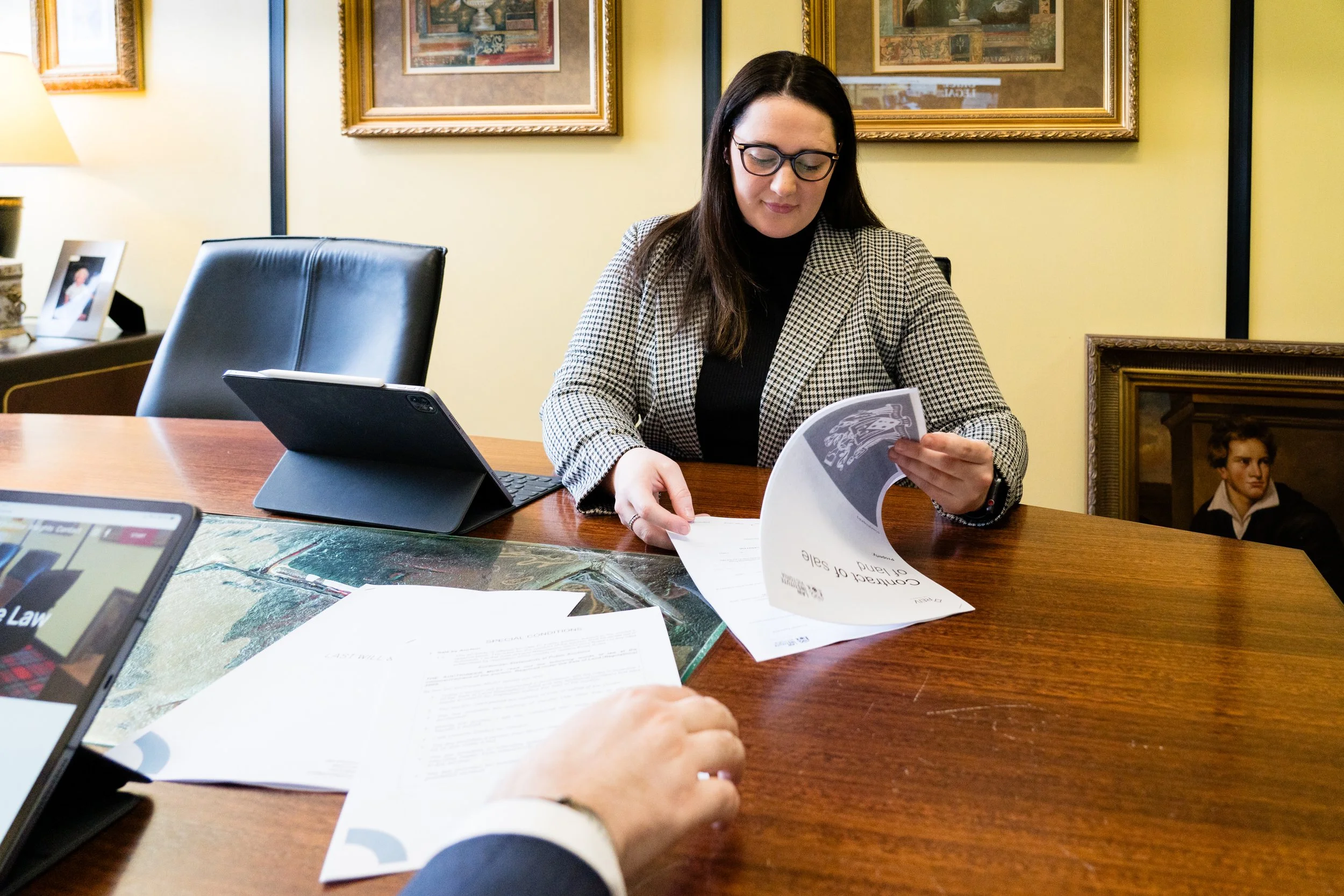
![Businesswoman reviewing and signing documents with a colleague at an office desk]()
Step 3 – Advice and strategy
We explain your rights and the realistic options, including the likely costs and risks of each.
-
![Businesswoman reviewing documents and taking notes at a desk while a businessman talks on a phone in the background]()
Step 4 – Negotiate or object
We write to the other party, neighbour or authority, or lodge an objection, and aim to resolve the matter without proceedings.




Understanding the cost of property law advice
Once we understand the issue and the assistance you need, we will discuss the likely costs with you and provide the required costs disclosure. This explains how our fees will be calculated and gives you an estimate of the likely legal costs, based on the information then available.
Costs depend on the type of issue and whether it resolves through negotiation or requires a tribunal or court application. Surveyors' fees, search fees and filing fees are additional. If the matter changes, we will discuss any material change in the likely costs with you.

Property law advice for Boroondara owners
Older properties in Boroondara often have historical fences, early subdivisions, single-dwelling covenants and easements that no longer match how the land is used. Rising land values can also make land tax and boundary issues more significant than they once were.
We advise owners, investors and neighbours across eastern Melbourne from our Balwyn office, and work with surveyors, accountants and town planners where needed.
Why Clients Trust Grice Legal
Grice Legal has been based in Balwyn since 1974. We are a boutique firm advising on family law, property and conveyancing, and wills, estates and structures, with a personal, senior-led approach.
Our Whitehorse Road office in Balwyn has served clients across Boroondara and eastern Melbourne for more than 50 years.
Local since 1974
You will know who is looking after your matter and can speak with them directly when questions arise.
Direct access to your lawyer
Conferences are available in person at our Balwyn office, by telephone or by video.
Meet in the way that suits you
Plain-English, practical advice
We explain your options, the risks and the next steps clearly, so you can make informed decisions.
We discuss the likely costs at the start and let you know if the estimate changes.
Open about costs
From Our Clients
-
![Five red stars aligned horizontally.]()
"Nicholas was a patient and a very good listener. He understood my concerns and gave advice accordingly. I feel that I am in good hands."
-
![Five maroon-colored stars in a row.]()
"After my appointment with Rachael I am confident that I now have the right person handle my legal issues."
-
![Five maroon stars aligned in a row.]()
"Our initial appointment certainly met and exceeded expectations. It was extremely informative and we received the advice we needed. Thank you!"
-
![Five maroon stars in a horizontal row.]()
"Anna was very professional, friendly and very helpful"
-
![Five maroon five-pointed stars in a row]()
"Rachael gives clear, informed goals. She shows understanding and empathy for your particular needs and sets outs steps to achieve them."
-
![Five red stars arranged in a horizontal row.]()
"Nicholas provided me with excellent, timely, professional service and I am confident he will continue to do so should I require it."
-
![Five maroon-colored stars in a row]()
"Anna was just a pleasure to have working for us. She was always clear and thorough, advocating for us and advising us along the way of buying our new house. We would totally recommend her and her service."
-
![Five maroon-colored stars aligned in a row.]()
"I found Grice Legal to be extremely helpful and efficient with their advice and prompt with all the required paperwork in completing my will requirement, veery approachable staff. I can fully recommend their services"

Property Law FAQs
-
Start by checking the title plan and, if needed, obtaining a survey from a licensed surveyor. Many boundary issues are resolved by agreement once the survey is available. If not, there are legal options, but the right approach depends on how long the fence has been there and how the land has been used.
-
Under the Fences Act 1968 (Vic), neighbours generally share the cost of a sufficient dividing fence equally. The process usually starts with a fencing notice. If the neighbours cannot agree, the dispute may be resolved through mediation or by the Magistrates' Court.
-
In limited circumstances. Under adverse possession, a person who has exclusively occupied land for at least 15 years, without the owner's permission, may be able to apply to become the registered owner. These claims depend heavily on the evidence, so obtain advice early if you suspect one may arise.
-
You can usually object to the assessment through the State Revenue Office. Strict time limits apply, generally 60 days from the date of the assessment notice, and you may still need to pay the tax while the objection is decided. Common issues include exemptions, surcharges and land valuations.
-
The principal place of residence exemption is the most common, but others may apply, for example for some primary production land or properties being built or renovated. Exemptions have specific conditions, and surcharges can apply to some owners, including trusts and absentee owners.
-
A caveat is a notice on the title that claims an interest in the land and prevents certain dealings from being registered without notice to the caveator. If a caveat is lodged without proper grounds, there are ways to have it removed, and the person who lodged it may be liable for compensation.
-
Sometimes. A covenant may be varied or removed through a planning permit application to the council or an application to the Supreme Court. The prospects depend on the covenant's wording, who benefits from it and whether those owners object.
-
An easement gives someone a right to use part of another person's land for a particular purpose, such as drainage, access or services. Easements are usually shown on the title or plan and can restrict building in that area.
-
Co-owners can apply to VCAT for orders that a property be sold or divided, and for the proceeds to be shared. VCAT can take into account contributions, such as mortgage payments or improvements. Negotiation is often the first step, but proceedings may be needed.
-
Many are resolved by negotiation or mediation once the facts are clear. Where proceedings are needed, the forum depends on the dispute. For example, VCAT deals with many co-owner, owners corporation and fencing-related matters, while some title disputes go to court.